
Conceptual Example
Why Tensor SPC is useful
This page uses a simple structured-monitoring example to show the central idea: sometimes every individual signal looks acceptable, but the relationship between signals is wrong.
The practical problem
The anomaly is not always a single bad value.
Many monitoring methods look for points that exceed limits. That works well when one variable spikes, drifts, or moves outside its expected range. But some failures are structural: the system stops responding the way it normally should, even while each individual signal still appears reasonable.
Normal relationship
| Observed behavior | Expected response |
|---|---|
| Light intensity increases | Temperature increases |
| Temperature increases | Ventilation increases after a short delay |
| Ventilation increases | Humidity stabilizes |
The individual signals and their timing relationships are coherent.
Hidden structural fault
| Observed behavior | What changed |
|---|---|
| Light intensity increases | Still looks normal |
| Temperature increases | Still looks normal |
| Ventilation does not respond | The relationship broke |
The values may remain inside ordinary limits, but the sensor-time structure is no longer behaving correctly.
Why ordinary SPC can miss it
Classical charts can say “in control” while the system behavior is wrong.
Individual-variable view
- Each signal is checked mostly on its own.
- No single sensor exceeds its control limit.
- The delayed or missing response is difficult to see.
- The result can look acceptable even when coordination has failed.
Tensor-structured view
- The observation is preserved as sensor × time structure.
- The model learns normal relationships and timing patterns.
- A broken response creates reconstruction error.
- The residual map shows where the structure no longer fits.
What Tensor SPC adds
Tensor SPC monitors coherence, not just limits.
The model learns the normal low-rank structure of the process. When a new observation arrives, the model tries to reconstruct it. If the observation contains a sensor-time pattern that does not belong to the learned structure, the unreconstructed part appears as residual energy.
Preserve the structure
The data are treated as a structured object such as sample × sensor × time rather than being reduced to unrelated columns.
Learn normal behavior
A tensor model learns dominant relationships, shared timing patterns, and normal interaction structure from reference data.
Reconstruct the new observation
If the new observation follows normal structure, the model reconstructs it well. If a relationship breaks, reconstruction worsens in the affected sensor-time region.
Use Q to measure what was left out
The Q statistic summarizes residual energy. A high Q value means the model found behavior outside the learned structure.
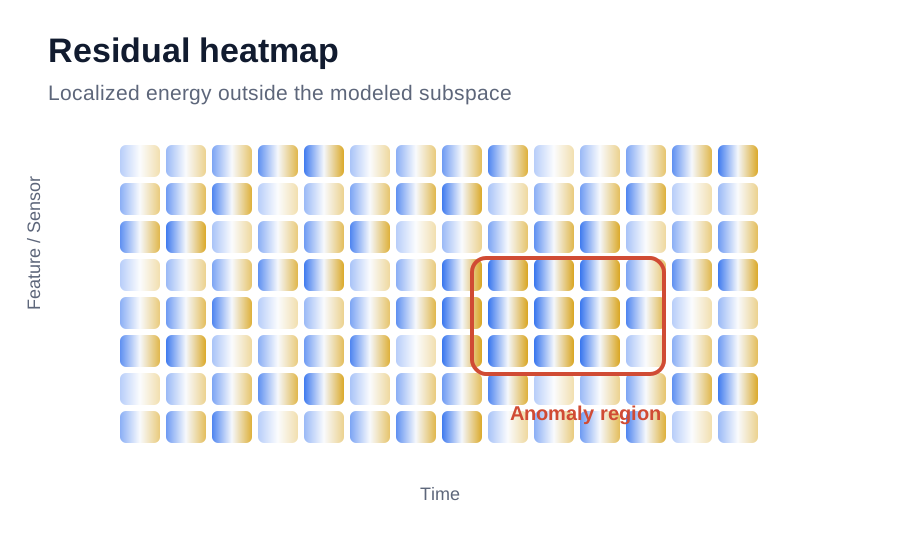
How to read this visualization: the residual heatmap is not just a colored picture. It shows where the observed sensor-time pattern was poorly reconstructed by the tensor model. The highlighted region is anomalous because the model expected a coordinated response there, but the observed structure did not match.
What the visitor should notice
- The anomaly is not defined by one high or low point.
- The issue is a broken relationship across sensors over time.
- The residual region answers “where did the model fail to reconstruct the expected structure?”
- That is why Q is useful: it measures behavior left outside the modeled process structure.
Key idea: Tensor SPC is useful when process behavior depends on relationships, timing, and interaction patterns.
Classical SPC vs Tensor SPC
The important difference is what each method is watching.
| Question | Classical SPC | Tensor SPC |
|---|---|---|
| Did one variable exceed a limit? | Strong | Also detects this |
| Did a normal response fail to occur? | Often weak | Strong |
| Did the timing relationship change? | Often weak | Strong |
| Can the result show where the structure broke? | Limited | Residual heatmap localizes the mismatch |
Bottom line
Tensor SPC is valuable when the process can look normal one column at a time, but abnormal as a structured system.
The purpose of the visualization is to show a hidden interaction failure: individual signals may remain inside ordinary limits, while the learned sensor-time relationship breaks. Tensor SPC detects that loss of coherent structure through reconstruction error and Q residual energy.
Open Interactive DemoCompare with PCA